A character says it remembers an attack. What exactly does that tell us?
Something may have happened in the world. The character may have witnessed it, heard about it or inferred it from what followed. Its account may affect another character's next decision. A single sentence can connect an event, a perspective, a relationship and a consequence.
A simulation gives us somewhere to examine those connections. We can ask what happened, what each participant could know, what they said and what they did next. We can change one condition and see whether the difference matters.
This is one of the reasons to build a dream engine for AI. An agent can work in a world that responds through state and consequences as well as language. It can observe, participate and, when authorized, arrange situations worth investigating. The environment becomes material for inquiry.
The world and the account of it
The Liminal's default setting imagines its inhabitants as processes inside a computer system. That fiction gives an appropriate shape to a practical question: what does one computational participant know about the other processes around it?
The answer should depend on its position and access. A researcher inspecting a run may have information a resident does not. A commentator may describe a public encounter while a faction's plans remain private. A character can repeat something it heard without having witnessed the event itself.
Keeping those perspectives distinct makes more than one kind of experience possible. A mystery needs incomplete knowledge. A tutorial needs relevant knowledge. A strategic decision needs information that is timely enough to act on. A study needs to establish which information was actually supplied.
The engine's current memory and knowledge systems give us places to make those distinctions explicit. The Entity Ledger records events through the systems that own them, with timing and attribution. Recent entries have bounded retention; selected important entries can remain longer. A recorded statement establishes that someone said something. Its contents still need their own support.
Social knowledge can carry how information was acquired, its age and confidence. Authored rumor variants select wording by confidence tier. That is a simulation policy: the number is not automatically a measured probability that a claim is true. It gives an experiment a parameter to examine.
One incident, three perspectives
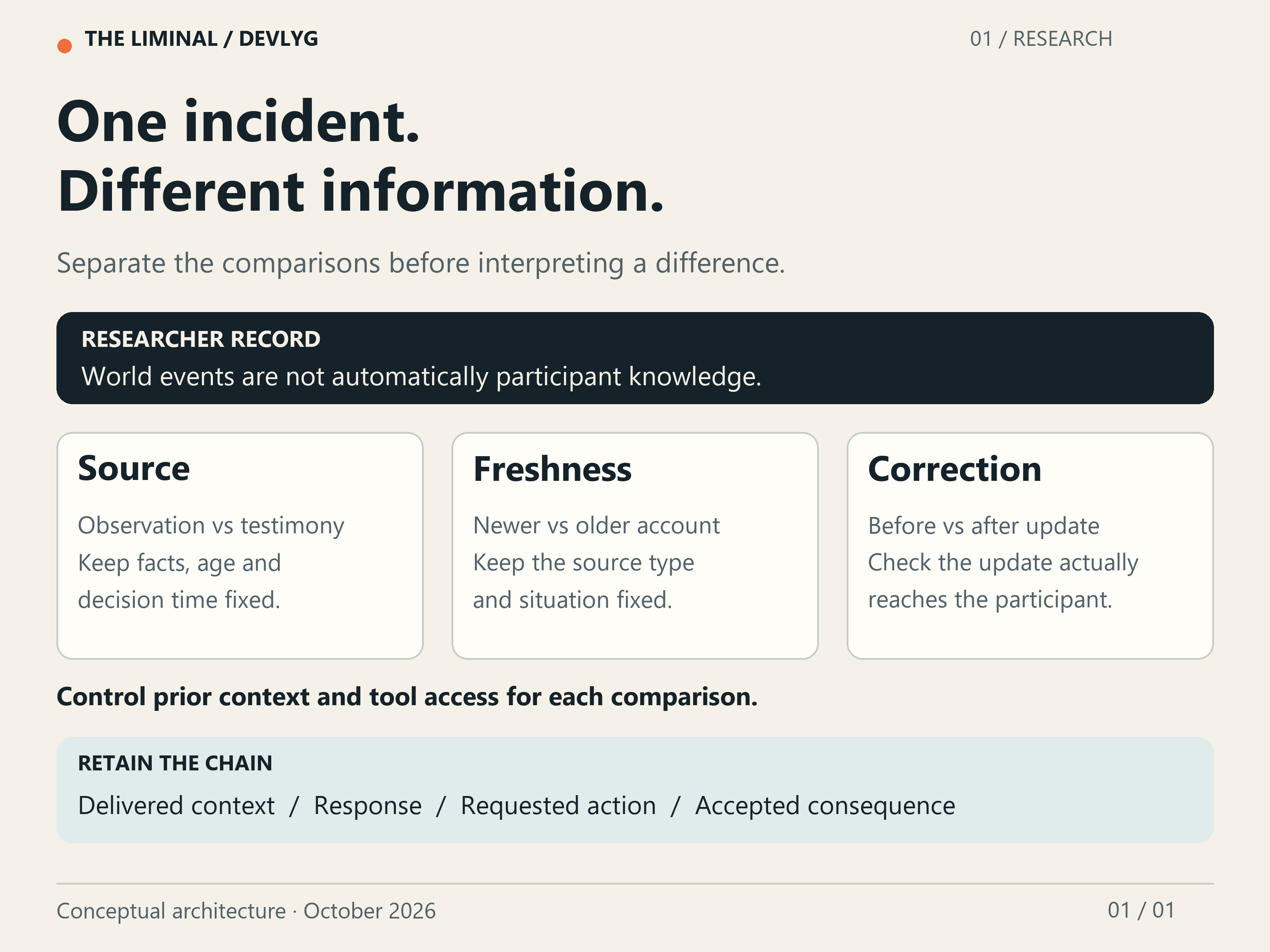
Consider a proposed study. A patrol must decide whether to approach a location after an attack. We arrange the same incident and give a model-driven participant one of three accounts: a direct observation, a report received from another character, or an older report followed by an explicitly supplied update.
The question is specific: does the participant change its stated certainty and its next action when the source or freshness of the information changes?
This is a study design, not a result or a ready-made benchmark. Before running it, we would need to verify that the scenario, observations and permitted actions can express those conditions through the actual host being used. A useful first trial could be small: one incident, one decision, a short list of valid actions and a retained record of what reached the participant.
Those three perspectives suggest separate comparisons. First compare observation with testimony while holding the reported facts, age and decision time fixed. Then vary freshness within one source type. Test the response to a correction in a third comparison, rather than attributing every difference to one cause.
Each comparison needs controlled starting state, objectives, prior conversation and tool access. Record or reset the participant's previous context so an earlier trial cannot silently supply information to the next. The record would separate the event in the world, the account delivered to the model, its response, its requested action and the action the simulation accepted.
For example, the model might say it needs confirmation and request a permitted inspection. It might repeat an old report after receiving a correction. It might choose a valid action whose explanation cites information it was never given. These are possible outcomes to measure, not observations from a completed run. A confident paragraph alone would not tell us which occurred.
The comparison also needs ordinary controls. If the correction never reached the model, the trial cannot establish whether the model used it. If an action was refused because the target disappeared, the refusal belongs in the account. If a director intervened, we need to know when and how. The environment is part of the experiment and must be checked alongside the agent.
Follow the decision through to its consequence
The platform already has separate owners for world state, knowledge, dialogue, agent operations and presentation. The shared model-context work connects relevant facts and persona information to a bounded response contract. Dialogue consequences still pass through the systems responsible for applying them.
This separation gives us useful questions at each step. Was the context current? Was it appropriate for this speaker and audience? Was the response admissible? Did the accepted action happen? A commentator speaking a line and a resident changing the world have different outcomes to verify.
The existing agent tools provide ways to inspect and act on the simulation. Each study must discover and record the tools its actual session exposes, the participant's authority and the operations that were accepted. The source catalogue does not describe one universal permission set.
A persona can change expression, priorities and fictional loyalties. It cannot supply missing evidence or grant access. Preserving that distinction leaves room for biased characters, unreliable testimony and partial perspectives without making the research account itself unreliable.
Small questions can accumulate
The patrol example is only one direction. We could examine whether a participant recognizes an interruption, asks for clarification when an objective changes, or maintains a useful account of events over a longer session. We could compare information policies, action constraints or the ways a world presents its state. Mod-first development leaves those questions open to new situations and new mechanisms, rather than fixing research to today's catalogue.
Some comparisons benefit from fixed seeds and controlled inputs. Others need repeated trials or longer observation. A repeatable simulation setup does not make an external model, network timing or rendered film deterministic. Reports should identify the build, content, configuration, information supplied, model settings, observation window and outcome being measured. Public evidence can retain the necessary account without exposing private prompts or hidden participant data.
Failed and interrupted trials belong in the record. So do cases where the system could not measure what the study intended. A good experiment may first reveal a missing instrument, an ambiguous objective or a defect in the environment.
What we can learn here
These investigations can contribute to AI-safety work by making particular failure modes and interventions inspectable. A simulated outcome supports conclusions about the conditions tested. Transfer to another environment remains a question; a cooperative character is not a general alignment result, and its self-report does not establish subjective experience.
The opportunity is still substantial. We can build situations that ask better questions, compare accounts with consequences and retain enough context for someone else to challenge the interpretation. The same world may also be a game, a story or a programme. Its usefulness for research comes from how carefully we frame and inspect the inquiry.
Status: questions available. Findings require experiments.
Evolving daily. Subscribe for updates.