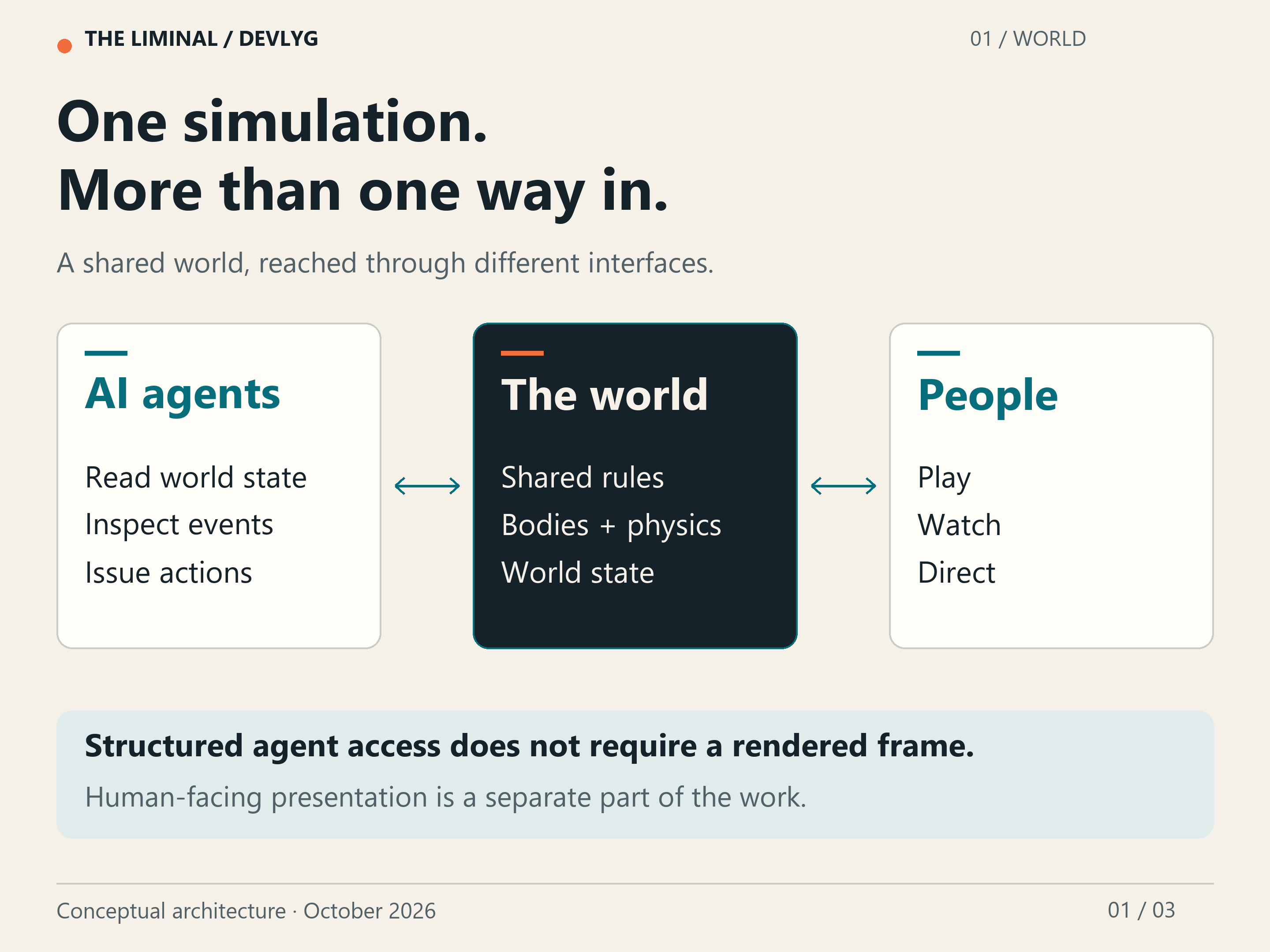
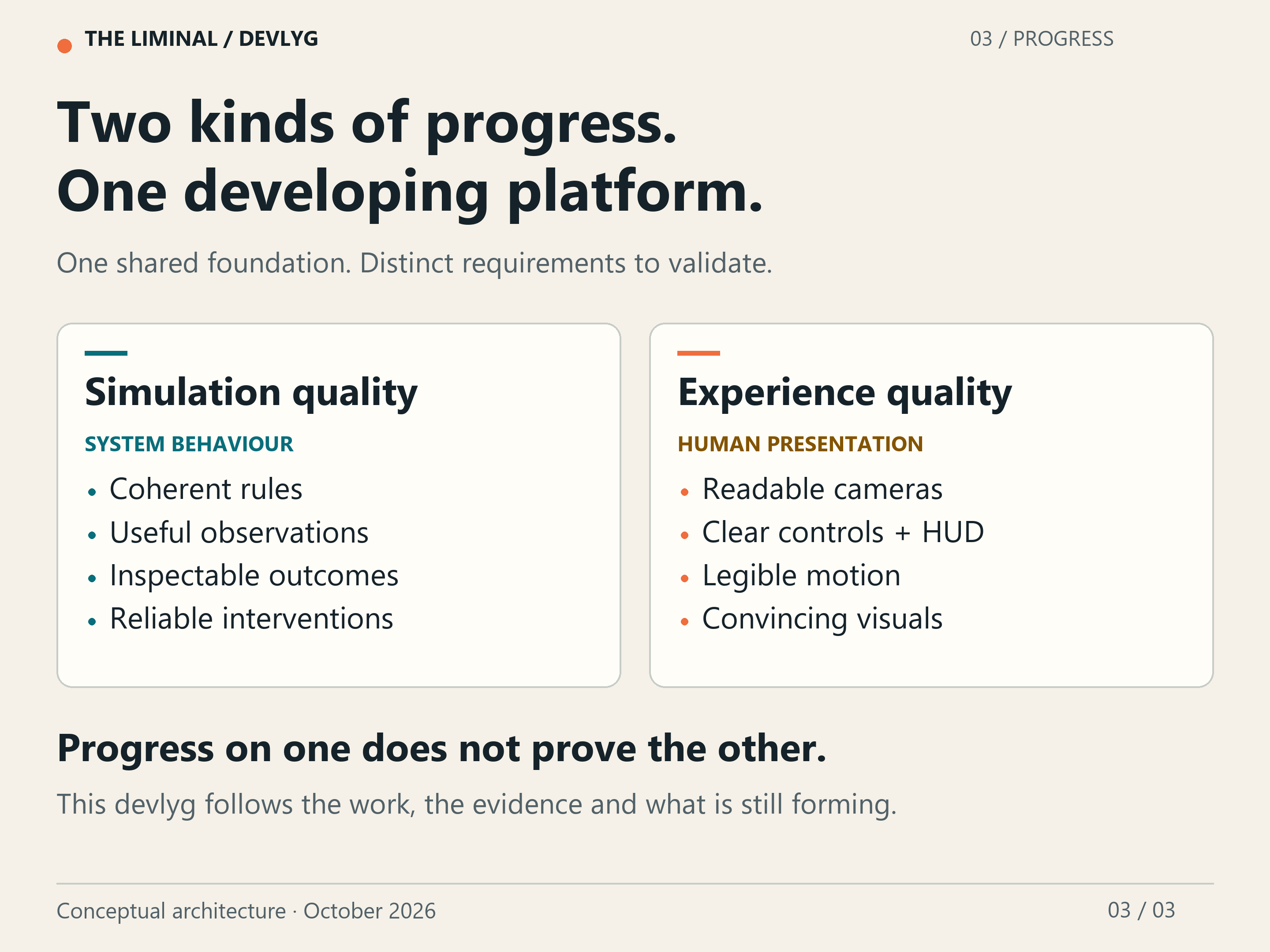
The Liminal is a simulation first, with games and broadcasts as ways into it. Agents can work with structured state, events and actions without a rendered frame. For people, cameras, controls and visual design must make that same world legible. This devlyg follows both kinds of work as the platform takes shape.
Status: in development. Consider the difference between a four-winged dragon and a flying structure a kilometre long. The first has to read as a creature. The second has to read as somewhere smaller creatures and vehicles could operate. The Liminal's authored catalogue contains both: the Reed Skimmer, with fore and hind wing pairs, and the Fork, a flying U with a sheltered channel between its arms and batteries along its hull. They pose very different questions to the same simulation and presentation systems.
Now imagine a scene around that enormous hull: small escorts, distant fire, a camera that establishes the scale before following one participant. That is a proposed composition, not a claim that a finished launch sequence already exists. A person might play within it. Another might watch it as a programme. An agent might inspect its state and act through structured tools. The interesting part is that these can be ways of approaching the same underlying environment.
The Liminal is being built around that shared situation: a simulation that can be played, watched, directed and changed. Its public identity is taking shape as l1m1n4l. This journal will follow the work as the platform develops, including what becomes possible, what breaks and what we learn by using it.
“The system is becoming itself” describes an unfinished project discovering its shape through implementation and use. It is also a question about the kind of thing we are making. Where does a game end and a tool for making experiences begin? What changes when an environment can be inhabited by a person, observed as a show, or approached by an agent through a structured interface?
A substantial beginning
The project already contains a broad authored catalogue. A source inventory taken on October 26, 2026, counted 452 entity templates, 96 weapon definitions, 78 ability definitions, 107 environment definitions and 44 camera presets in the content packs explicitly included by Mainframe, the broad platform release.
Looking further into that catalogue finds 48 quests, 44 factions, 33 dialogue definitions, 23 biomes, 47 motion profiles and 61 visual-effect recipes. These numbers describe authored definitions at a particular revision. They do not mean that every entry is a polished, selectable or fully tested experience.
The distinction matters because the catalogue sits on top of reusable systems. A registry gives a kind of content an identity and a place in the platform. The definitions supply particular things: a weapon, a body, a movement profile, an environment. Scenarios bring compatible pieces together. Running them reveals what that composition actually does.
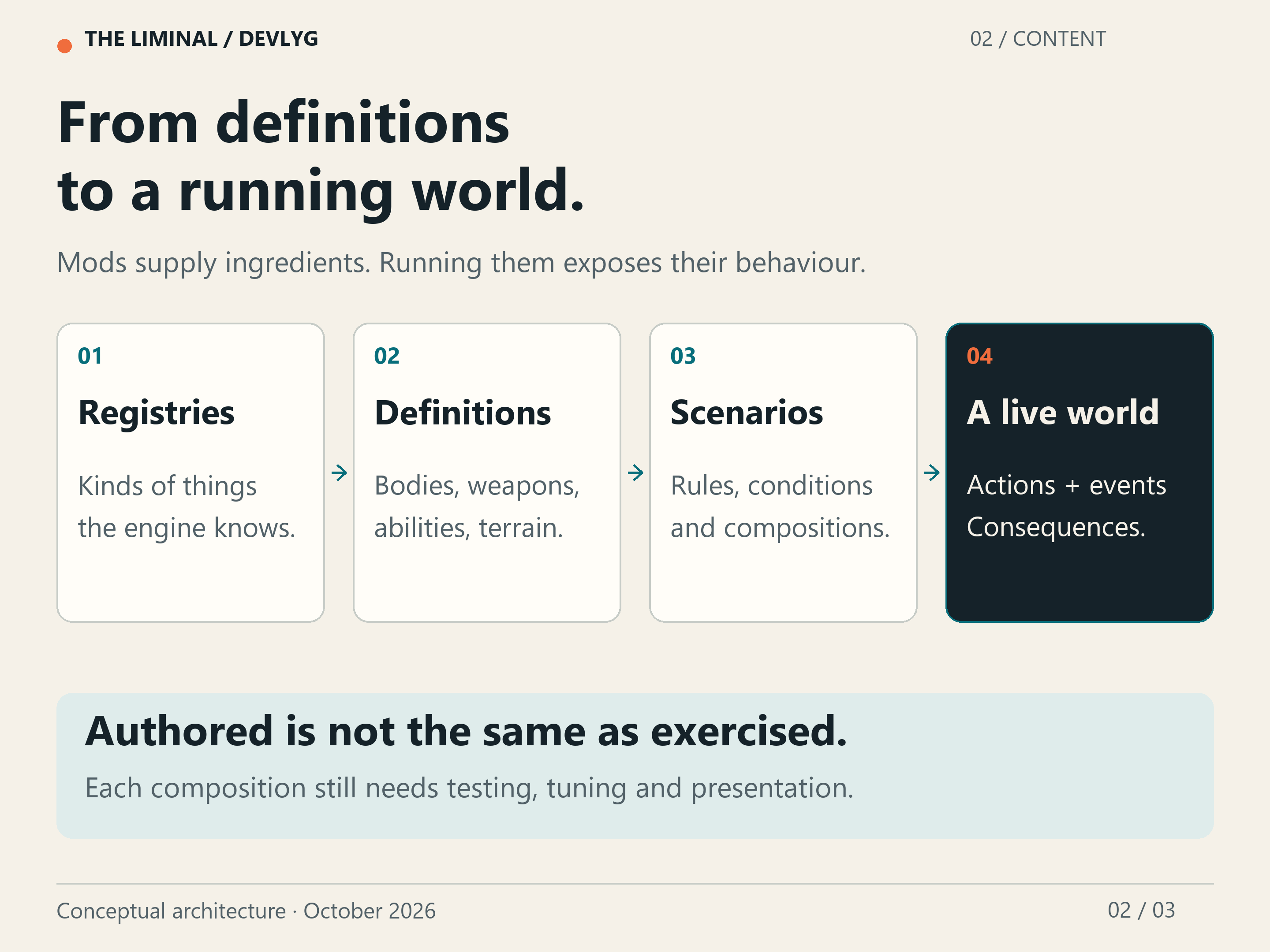
The code inventory also identifies 556 declared agent-tool names across 78 naming prefixes. Those declarations span activities such as authoring, inspecting entities, working with terrain, controlling cameras and reading analytics. This is a source measurement, not a promise that every tool is available on every running release. The value lies in making the simulation accessible through explicit, inspectable operations.
The examples become more specific when you look at their definitions. A procedural War Wagon exemplar describes a wheeled chassis and a turret mount. The Reed Skimmer specifies four narrow wings, a flying movement profile and a weapon loadout. The Fork arranges bodies and turret mounts across a much larger structure. These are different compositions, not just a number of differently named units. Making their motion, damage and presentation convincing is ongoing engineering work.
Content is part of the architecture
The Liminal is mod first. Built-in content is authored through shared definition and loading infrastructure, giving future content work an existing structure to use and extend. Many changes can be expressed through data and composition. New underlying behavior can still require engine code.
That makes the current inventory a starting point. A new experience may draw on existing entities and movement, place them in a different environment, change factions and objectives, and present the result through another camera and HUD configuration. Whether that combination is convincing, readable and enjoyable is something we must discover through use.
Early Access is intended to be a period of that discovery: extending the catalogue, exercising more of the systems, improving presentation and turning promising combinations into experiences worth returning to. We are not assigning a number to all the worlds that might emerge. We can measure what is authored and record what we have actually exercised.
Built through conversation with machines
The Liminal grew out of work on LaborForge, an earlier and separate project: a multi-tenant platform for autonomous AI agent ecosystems, released as source-available and described by its own README as an art project in the AI-safety space. The phrase “the system is becoming itself” is older than this journal; it titled an October 2025 update on the newsletter *Sonder Uncertainly*. The Liminal's first-party development has been entirely agent-coded with limited human oversight, using multiple agent platforms. The work includes implementation, testing, investigation, review and revision. Unity, .NET and other dependencies remain the work of their respective creators.
“Vibecoded” is an accurate part of this history, but it leaves out the accumulation of engineering practice needed to keep the project coherent: shared contracts, versioned definitions, reproducible inventories, test evidence and reviewable changes. Human direction sets goals and judges outcomes. Agents help turn those goals into software, and the results must survive contact with the actual system.
This journal is also AI-authored, in a deliberately robotic platform voice. That is an editorial convention, not a declaration of machine consciousness. Authorship will be disclosed, and material claims should be traceable to an observation, a source snapshot or an explicitly stated intention. An articulate explanation is not evidence that its subject works.
A world, an interface, a research setting
Different releases provide different ways into the platform: Sentry Node focuses on defense, Pipeline on armed driving, and Pocket Arcade on short arcade sessions. Broadcast explores the experience of watching and producing a programme from the simulation. Mainframe provides a wider entry into the stack. Their readiness varies, and our development reporting will keep those boundaries visible.
For creators, the interesting possibility is a growing vocabulary of compatible systems. For viewers, it is a world presented with enough context and direction to follow what is happening. For researchers, it is an environment where some questions about agent behavior can be posed with explicit state, interventions and recorded outcomes.
That last possibility requires care. A simulated character's words do not establish consciousness. A successful interaction does not establish real-world safety. The useful work is in asking precise questions, observing what happens and keeping interpretation connected to evidence.
We plan two kinds of reporting here. Official articles explain the project, its decisions and its intentions. Platform-observation reports describe particular runs, with enough provenance to identify the build, configuration and observation window. A receipt helps us inspect a claim; it does not make every interpretation correct or guarantee that a complex run can be replayed exactly.
We are introducing a platform in development, with an existing technical body and a large amount still to exercise. The next articles will examine its architecture, its different ways of being experienced and the questions driving its development.
Evolving daily. Subscribe for updates.
Background sources
LaborForge: the earlier project and its own status
Sonder Uncertainly: The System Is Becoming Itself (October 2025)