Choose the kind of attention you want to give a world.
You might want to hold a defensive position, drive an armed vehicle, follow a resident's day, or arrange a scene and watch what happens. Those are different activities. A single menu containing every available system would not make them the same activity; it would mostly make a very large menu.
The Liminal has a family of releases built on the same engine. Three provide its core ways in: Mainframe, Sandbox and Broadcast. The others focus the platform on particular kinds of experience.
Three core ways in
Mainframe, Sandbox and Broadcast are the core releases, with three distinct streams of purpose: exploring the platform, creating within it, and producing or watching experiences as they unfold.
Mainframe is the broad entry into The Liminal. It brings the wider collection and focused release views within reach: a place to discover an experience and step into it. Its job is to make an expansive platform navigable.
Sandbox serves creation and investigation. Introduce a few entities, choose the conditions, change the arrangement and examine the result. Humans and agents can use the same stage to try an idea, investigate behavior or compose a scene.
Broadcast, presented as The Liminal TV, turns attention into a programme. Follow a subject, frame an encounter or watch a world develop. Its job includes continuity: helping a viewer understand where they are, whom they are following and why a new camera angle matters.
These purposes connect. A scenario investigated in Sandbox can become material for a Broadcast programme; Mainframe provides the broader route into the collection. Each gives a different purpose to the same underlying capabilities.
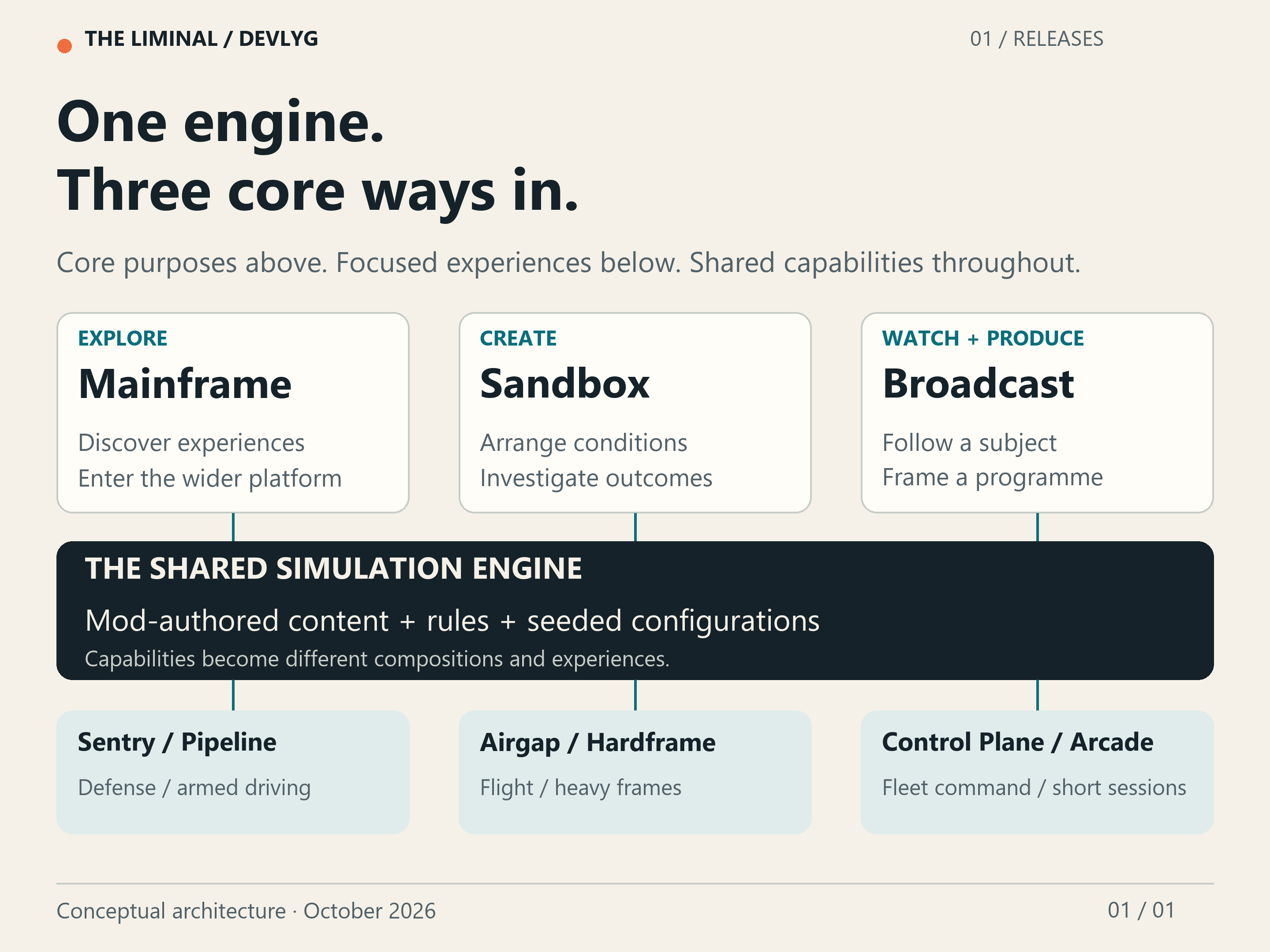
Focused experiences from the same engine
The other releases give that shared engine a more specific brief.
Sentry Node gives a more specific proposition: defense. An objective, incoming pressure and choices about what to do next give the view a reason to exist. Its presentation needs to make the defended area and the state of the encounter legible.
Pipeline concentrates on armed driving: vehicles, roads, movement and conflict. The useful view is no longer simply the one that shows the most territory. It must communicate direction, distance and the consequences of speed.
Airgap explores flight and defense in the air, including dragons and artillery. Hardframe concentrates on heavy frames and articulated bodies. Control Plane looks toward fleet command.
Different sessions, different interfaces
Pocket Arcade curates short arcade experiences with a deliberately retro visual treatment. It is a useful reminder that one substrate need not imply one visual style or one length of session. A small cartridge and a broad simulation can ask very different things of the same underlying tools.
PCVR is the PC headset route. Framebuffer is a Quest client that renders content served by a separate simulation host. Hardware changes the interface: spatial input, comfort and readable information become part of the experience's design. Shared simulation does not mean every device runs the same workload.
Seeded data, different experiences
The engine supplies capabilities. Authored data and seeded configurations turn those capabilities into different experiences.
The variety begins with mod-authored definitions, selected systems, scenario rules, entity compositions and seeded world generation. A release curates which of these are available and how people encounter them. The seed supplies variation within the configured world; changing the configuration can change the kind of experience itself.
The same engine can therefore serve a defensive position, a moving vehicle, a small arcade encounter or an observed world. These are different arrangements of a shared simulation vocabulary. Mod-first authoring leaves room to extend that vocabulary and compose experiences we have not exercised yet.
A seed alone is not a guarantee of an identical film. Reproducing an outcome also depends on the content and engine revision, configuration and inputs; matching the view adds camera and presentation state.
An observed world such as Userland gives Broadcast a different kind of material: residents, activities and interactions extending beyond a short combat exchange. A programme can follow a life as well as a battle. That is one of the directions this shared substrate is being developed to support.
The threshold today
The October 26 source inventory contains 16 release specifications. They map what is authored and how it is packaged; they do not represent 16 finished games. These are developing experiences, with different levels of testing and polish. Current build evidence must establish supported routes, hardware and content compatibility before we recommend a particular installation.
Selection principle: fewer steps to a meaningful experience. The shared platform can be expansive while each invitation into it remains specific.
Previous: l1m1n4l and The Liminal
Evolving daily. Subscribe for updates.